Identity Governance Doesn’t Have an Automation Problem. It Has an Understanding Problem.
Identity teams don’t lack tools. They lack the one thing every decision depends on — a clear view of what’s actually true.
Read Now


For many ServiceNow owners and platform managers, success is measured in adoption, efficiency, and business outcomes.
Is the platform being used across teams?
Are workflows replacing manual work?
Is the organization consolidating processes instead of adding more tools?
And yet, one of the most critical enterprise functions often lives outside the platform’s core workflows: Identity governance.
Access requests, certifications, and lifecycle changes still tend to run through disconnected systems, spreadsheets, or standalone tools—creating friction between IT, security, compliance, and HR.
The result isn’t just inefficiency, tt’s misalignment. And for platform owners, misalignment is one of the biggest threats to long-term value.
Most organizations don’t set out to create silos. They accumulate them.
Over time, access management, security operations, compliance, and HR each adopt tools optimized for their own needs. Individually, those tools work. Collectively, they don’t.
This shows up in familiar ways:
Each team sees only part of the picture and ServiceNow owners are often left trying to connect it all.
Identity sits at the intersection of nearly every enterprise workflow. Onboarding touches HR, IT, facilities, and security while role changes affect access, approvals, and compliance. And terminations trigger deprovisioning, audits, and risk controls.
When these processes run in separate systems, alignment depends on email, handoffs, and tribal knowledge. When they run on the platform, alignment becomes built in. This is where identity workflows change the game.
Instead of managing identity “next to” ServiceNow, leading organizations are embedding it into:
Identity stops being a separate function and becomes shared infrastructure.
Consider a global services firm modernizing its access processes.
Before:
Each team did its job—but coordination was slow and brittle. After aligning identity workflows on the platform:
Nothing “magical” happened. They simply stopped moving identity between systems, which increased efficiency and reduced risks inherit with any integration. And alignment followed.
When identity workflows live on ServiceNow, platform owners begin to see tangible results:
Many organizations try to solve fragmentation with integrations by connecting identity tools to ServiceNow, sync data, and build connectors. This helps—but only to a point.
Integrations still mean:
Workflows remain distributed.
Accountability remains fragmented.
True alignment requires unification.
When identity governance runs natively on ServiceNow, organizations gain:
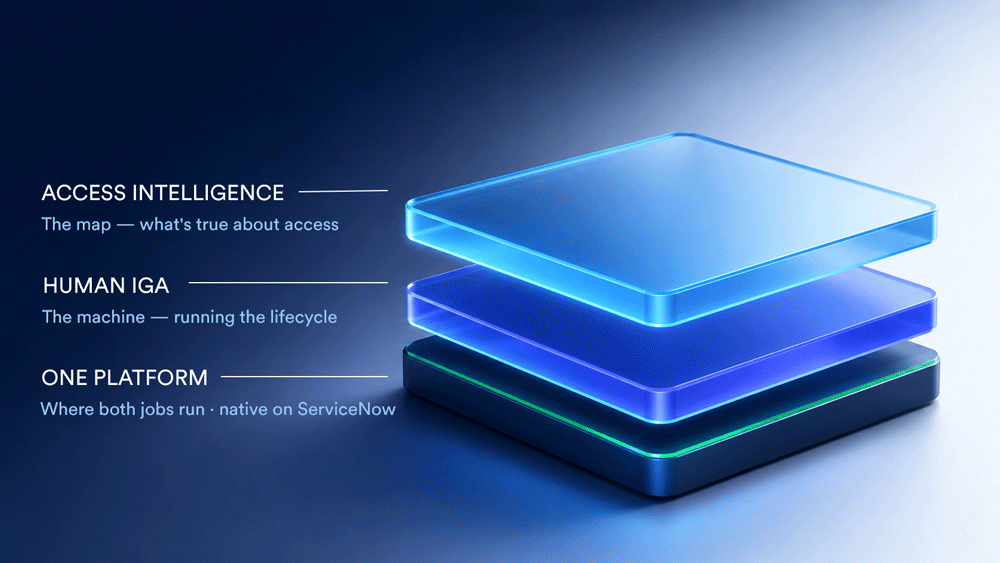
This is why Clear Skye was built on the platform from day one.
Not connected.
Not bolted on.
Native.
It allows identity to participate in enterprise workflows instead of orbiting them.
For ServiceNow owners, identity governance represents one of the most underutilized opportunities on the platform.
Done well, it becomes:
Done poorly, it remains a source of friction — the difference becomes architectural.
If you’re exploring how identity workflows can unify IT, security, and compliance on your ServiceNow platform, a hands-on view is often the fastest way to understand what’s possible.
Explore Clear Skye’s self-guided demo to see how platform-native identity governance works in practice.