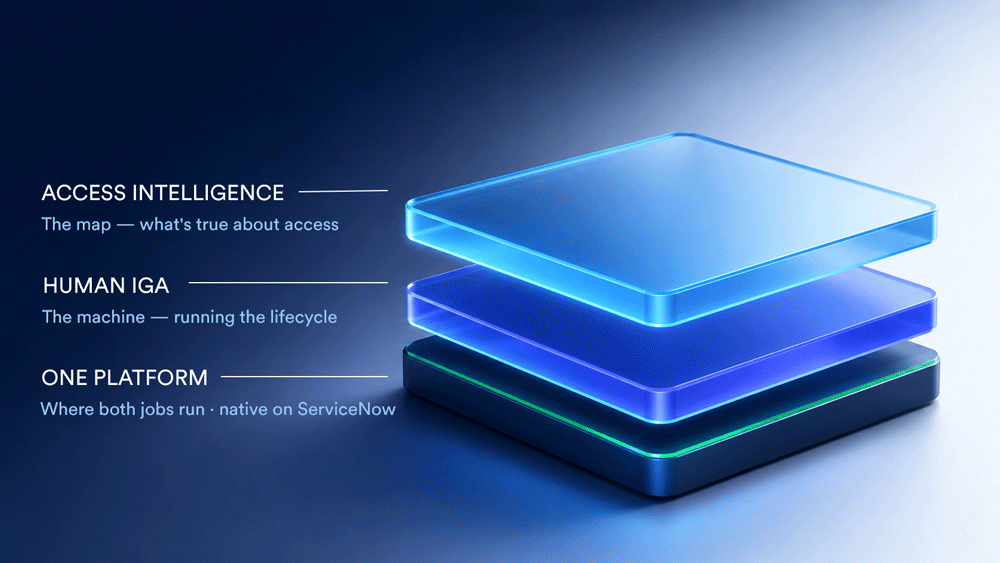
Identity Governance Doesn’t Have an Automation Problem. It Has an Understanding Problem.
Identity teams don’t lack tools. They lack the one thing every decision depends on — a clear view of what’s actually true.
Read Now


When a platform company spends more than a billion dollars in a category, it usually signals something larger than a single product acquisition.
ServiceNow’s purchase of Veza is one of those moments.
For years, identity has been described as “the new perimeter.” But the reality inside most enterprises has been far more complicated. Identity data is fragmented across systems. Access decisions require manual investigation. Governance processes are slow, opaque, and difficult to scale.
At the same time, organizations are moving toward more automated workflows, more distributed systems, and now—AI agents acting on behalf of employees.
That combination is pushing identity to the center of the enterprise platform conversation.
ServiceNow’s acquisition of Veza is a clear signal that identity is becoming foundational to the platform itself.
Historically, identity governance focused on managing access for people—employees, contractors, partners—ensuring the right individuals had the right access at the right time.
But that scope is expanding quickly.
As organizations begin deploying AI agents across business workflows, identity is no longer just about people. It’s also about understanding what machines and automated agents can access, what actions they can take, and how those permissions are governed.
That shift introduces new complexity for security teams, platform owners, and identity leaders.
Governance must now extend across human identities, machine identities, and increasingly AI-driven processes.
Solutions like Veza have focused on improving visibility into those relationships by mapping access across complex environments. That kind of visibility becomes increasingly important as organizations adopt AI-driven automation.
But visibility alone does not solve the operational side of identity governance.
While identity visibility and security posture are gaining attention, most organizations still struggle with the operational side of identity governance.
The day-to-day work of identity includes processes such as:
These processes touch nearly every employee and application inside an organization.
They also represent one of the most complex workflow challenges inside enterprise IT.
That is why many organizations are rethinking where identity governance should live architecturally.
ServiceNow has increasingly positioned itself as the platform that connects workflows across the enterprise—from IT service management to risk management to security operations.
Identity governance naturally fits within that ecosystem.
Access decisions are rarely isolated events. They connect to employee lifecycle events, service catalog requests, security policies, and compliance workflows.
When identity governance lives directly on the platform where those processes already operate, organizations gain something difficult to achieve with disconnected tools: workflow continuity.
Access requests, approvals, investigations, and compliance evidence can all operate within the same data model and workflow engine.
That architectural alignment is one reason identity has become an increasingly important topic inside the ServiceNow ecosystem.
For Clear Skye, this moment represents validation of a long-standing belief.
More than ten years ago, Clear Skye set out to build identity governance natively on the ServiceNow platform, rather than connecting external identity tools through integrations.
That approach was based on a simple premise: identity governance works best when it operates directly inside the workflows organizations already rely on.
Today, organizations use Clear Skye on ServiceNow to manage core identity governance processes including access requests, certifications, lifecycle management, and compliance controls—directly within the platform.
As identity continues expanding to support new models of automation and AI-driven systems, that platform-native approach becomes even more important.
The Veza acquisition signals that ServiceNow sees identity as a critical part of the platform’s future.
For customers, partners, and the broader identity community, that’s an encouraging development.
Identity is becoming more central to how organizations operate, secure systems, and manage risk.
And increasingly, those identity processes are moving closer to the platforms where work actually happens.
The result is a new phase for identity governance—one where visibility, governance, automation, and platform workflows converge.
Clear Skye is proud to be part of that evolution.